
Protect your business with layered defences: filter email to stop phishing, patch and protect every device, enforce multi-factor authentication, segment your network behind a business firewall, and keep tested 3-2-1 backups with an offsite, immutable copy. No single tool is enough on its own. Cybergate designs and manages these layers for Malaysian SMEs and aligns them with the PDPA so you can recover quickly even if you are attacked.
What is ransomware, and why are Malaysian SMEs targeted?
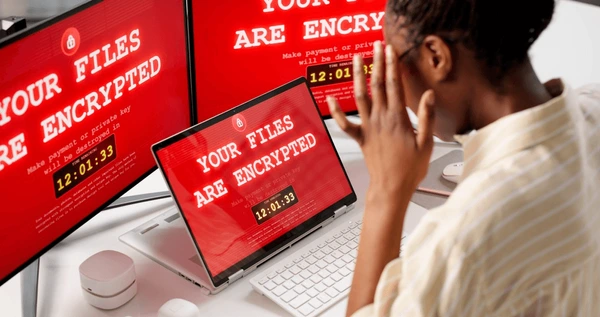
Ransomware is malicious software that encrypts your files and systems, then demands payment for the key to unlock them. Modern ransomware gangs also steal a copy of your data first and threaten to publish it, a tactic known as double extortion, which means even a good backup does not remove every consequence.
Many Malaysian small and medium businesses assume they are too small to be a target. The opposite is true. Attackers use automated tools that scan the internet for any vulnerable business, and SMEs are attractive precisely because they often have weaker defences, limited in-house IT, and just enough cash flow to pay. A single successful attack can halt operations for days.
The goal of this guide is simple: give you a clear, practical understanding of how ransomware reaches a business and the layered defences that genuinely reduce your risk, written for business owners rather than IT specialists.
How ransomware gets into a business
Almost every ransomware incident starts with one of a small number of entry points. Understanding them tells you exactly where to focus.
- Phishing email: a staff member clicks a link or opens an attachment that installs the malware or steals a password.
- Stolen or weak passwords: attackers log in with leaked credentials, often through remote access left exposed to the internet.
- Unpatched software: known vulnerabilities in Windows, servers or applications that were never updated.
- Exposed remote desktop (RDP): a remote access port open to the world is a favourite way in.
- Infected downloads or USB drives: pirated software and unknown devices remain a common source.
The encouraging news is that these vectors are well understood and largely preventable. The layers below map directly onto them.
The real cost of a ransomware attack
The ransom itself is often the smallest part of the damage. The larger costs are downtime while systems are rebuilt, lost orders and productivity, the effort of recovery, and the long-term hit to customer trust if data is leaked.
For Malaysian businesses there is also a compliance dimension. If personal data is exposed, you have obligations under the Personal Data Protection Act 2010, including assessing the breach and notifying affected parties where there is a risk of harm. You can read more in our PDPA 2026 compliance guide.
When you weigh prevention against the cost of a single incident, layered protection is one of the cheapest investments a business can make.
Layer 1: Stop threats at the email
Because most attacks begin with phishing, email security is your first and most valuable layer. Modern email filtering scans links at the moment they are clicked and inspects attachments in a safe environment before they reach the user.
Pair this with simple habits: verify unexpected requests, never enable macros in documents from outside the company, and treat urgent payment or password messages with suspicion. Our article on phishing examples for Malaysian SMEs shows the exact tactics to watch for.
If you use Microsoft 365 or Google Workspace, much of this protection is available in the right plan and simply needs to be configured correctly, which is part of every Cybergate deployment.
Layer 2: Secure and patch every device
Every laptop, desktop and server is a potential entry point. Each one needs modern endpoint protection that detects ransomware behaviour, not just known viruses, and each one needs to be kept patched so known vulnerabilities are closed quickly.
Patching sounds simple but is where many businesses fall down, because it is easy to forget and hard to track across a growing fleet. This is exactly what ManageEngine Endpoint Central Cloud automates: it patches operating systems and third-party applications on a schedule and gives you a single view of every device.
Unmanaged or out-of-date machines are the soft targets attackers look for, so closing this gap removes a large share of your risk.
Layer 3: Lock down access with MFA and least privilege
Multi-factor authentication (MFA) is the single most effective control against stolen passwords. Even if a password is leaked, the attacker cannot log in without the second factor on the user's phone. Enforce MFA on email, remote access and any business application that supports it.
Apply the principle of least privilege as well: staff should only have access to the systems and data they genuinely need, and day-to-day accounts should not have administrator rights. This limits how far an attacker can spread if one account is compromised.
Finally, never expose remote desktop directly to the internet. Use a secure, access-controlled method instead, which we set up as standard for clients who need remote access.
Layer 4: Firewall and network segmentation
A business-grade firewall, such as a Fortinet unit, filters traffic at the edge of your network, blocks known malicious sources, and gives you visibility of what is happening. It is a meaningful step up from the basic router supplied by an internet provider.
Network segmentation adds another barrier by separating parts of your network, for example keeping guest Wi-Fi, payment systems and general office devices apart. If one segment is compromised, the others are not automatically exposed.
These measures are part of our managed cybersecurity service, sized and configured for your business rather than left on default settings.
Layer 5: Backups that survive ransomware
If every other layer fails, backups are what get you back in business without paying a ransom. But not just any backup. Modern ransomware actively seeks out and encrypts backups that are connected to the network, so the way you back up matters as much as the fact that you do.
The proven approach is the 3-2-1 rule: keep three copies of your data, on two different types of media, with one copy offsite. Add an immutable or snapshot-protected copy that cannot be altered or deleted, and you have a recovery point ransomware cannot reach.
Crucially, backups must be tested. A backup you have never restored is only a hope. We monitor and test restores as part of our backup and disaster recovery service, so you know recovery actually works before you ever need it.
Layer 6: Train your team
Technology stops most attacks, but your staff are the final layer. Short, regular awareness training that teaches people to recognise phishing, verify unusual requests and report suspicious messages dramatically reduces the chance of a successful attack.
Make reporting easy and blame-free. The goal is for an employee who clicks something they should not have to tell you immediately, because fast reporting often means the difference between a contained incident and a full outbreak.
What to do if you are hit by ransomware
Even with strong defences, you should know the steps in advance. Acting quickly and calmly limits the damage.
- Isolate: disconnect affected devices from the network immediately to stop the spread.
- Do not pay yet: get professional advice first. Paying does not guarantee recovery and may not be necessary if your backups are intact.
- Preserve evidence: do not wipe machines before they can be examined.
- Assess the data: determine what was affected, including any personal data, for your PDPA obligations.
- Recover from backup: rebuild clean systems and restore from a known-good, offline copy.
- Review and harden: close the gap that allowed the attack so it cannot happen again.
Having an incident response plan written down before anything happens turns a crisis into a procedure. We help clients prepare and test this as part of managed security.
Ransomware and your PDPA obligations
If a ransomware attack exposes personal data of customers or staff, it is treated as a personal data breach under Malaysian law. You are expected to assess the incident and, where there is a risk to individuals, notify the relevant parties without unreasonable delay.
Being prepared makes this manageable: documented security controls, tested backups and a clear response plan all demonstrate that you took reasonable care, which matters both legally and for customer trust. Our guide to PDPA breach notification explains the timeline and steps.
Common ransomware myths that put SMEs at risk
Myth one: we are too small to be targeted. In reality most attacks are automated and indiscriminate, scanning for any business with a weak point, so size offers no protection at all.
Myth two: our antivirus will catch it. Traditional antivirus only recognises known threats, while modern ransomware constantly changes to slip past it. Behaviour-based endpoint protection is needed instead.
Myth three: we have backups, so we are safe. Backups only help if they are offline or immutable and have been tested. Ransomware deliberately hunts for and encrypts connected backups, which is why so many businesses with backups still cannot recover.
Ransomware risk by industry in Malaysia
Different industries face different pressures, but all are targets. Knowing your specific exposure helps you prioritise.
- Clinics and healthcare: patient records are sensitive and downtime affects care, making clinics a high-value target with clear PDPA exposure. See IT support for clinics.
- Law and accounting firms: confidential client files and trust accounts make these firms attractive and reputationally fragile.
- Manufacturing: an attack that halts production or ERP systems stops revenue immediately, so uptime is everything.
- Retail and e-commerce: payment data and customer records, plus the cost of every hour the store or site is down.
Whatever your sector, the defensive layers are the same. What changes is the priority order and the compliance stakes, which is why we tailor protection to each client's industry.
How remote and hybrid work changes your ransomware risk
Work-from-home and hybrid teams expand the number of devices and networks that can be a way in. Home Wi-Fi, personal laptops and unmanaged machines all widen the attack surface if they are not brought under control.
The answer is not to ban remote work but to manage it: enforce MFA, keep remote devices patched and protected through cloud-managed endpoint tools, and provide secure access to any on-premise systems. Our guide on WFH cyber threats goes deeper on this.
Done properly, a remote team can be just as secure as an office-based one, because every device is monitored and protected wherever it happens to be.
How Cybergate protects Malaysian businesses end to end
Assembling and maintaining all of these layers is exactly what a managed IT and security provider does. Rather than buying tools piecemeal and hoping they stay configured, you get a single team that designs, runs and reviews your protection.
We start with a free security assessment that shows your real gaps, then implement the priorities: MFA, patching, endpoint protection, email filtering, firewall and tested backups, all aligned with the PDPA. From there we monitor and maintain everything so your defences do not quietly drift out of date, which is the most common reason businesses get caught out.
Because we also handle your day-to-day managed IT support, security is not a separate bolt-on but part of how your whole environment is run, which is far more effective than treating it as an afterthought.
Ransomware trends Malaysian businesses should watch
Ransomware keeps evolving, and a few trends matter for 2026. Double extortion, where attackers steal data before encrypting it, is now standard, so a backup alone no longer removes the threat of a leak. This raises the importance of stopping intrusions early and protecting data, not just being able to restore it.
Ransomware-as-a-service has lowered the skill needed to launch attacks, meaning more attackers and more attempts against ordinary SMEs. At the same time, attackers increasingly target backups, cloud accounts and managed service connections, so securing identities with MFA and protecting backups have become more important than ever.
The practical takeaway is that defence cannot be a one-time project. Threats change, so your protection has to be monitored and updated continuously, which is the core reason a managed approach outperforms a fix-and-forget setup.
Building a security-first culture
The most resilient businesses treat security as a habit, not a product. That means leadership visibly supports good practice, new staff are briefed on day one, and simple rules, such as verifying payment changes by phone and never reusing passwords, become second nature.
It also means reviewing your posture regularly. A short quarterly check of who has access to what, whether backups are still running and being tested, and whether every device is patched will catch the drift that quietly reopens gaps over time.
None of this requires a large budget or a dedicated security team. With the right partner and a few consistent habits, a Malaysian SME can reach a level of ransomware resilience that was once only realistic for large enterprises.
Why prevention is far cheaper than recovery
It is tempting to delay security spending until something goes wrong, but the maths rarely supports waiting. The cost of a single ransomware incident, counting downtime, lost orders, recovery effort, possible data leakage and the hit to customer confidence, almost always dwarfs the modest monthly cost of layered protection.
Prevention is also predictable. A managed security plan turns an unknown, potentially business-ending risk into a small, fixed monthly figure you can budget for, while shifting the day-to-day work of patching, monitoring and testing onto a team that does it for a living.
Perhaps most importantly, prevention protects the things that do not appear on an invoice: the trust your customers place in you, the reputation you have built over years, and the simple ability to keep operating without interruption. For a Malaysian SME, those are worth far more than the price of getting protection right.
Key takeaways
Ransomware is a realistic threat for every Malaysian SME, but it is also highly preventable. The businesses that get hit hardest are almost always the ones missing a few basic layers, not the ones facing some unstoppable attack.
Focus on the fundamentals first: multi-factor authentication on every account, consistent patching, modern endpoint protection, email filtering, a business firewall, and tested 3-2-1 backups with an offsite, immutable copy. Add staff awareness and a written response plan, and you have closed the gaps attackers rely on.
If you would like a clear picture of where your business stands today, book a free security assessment with Cybergate. We will show you your real gaps and the priority fixes, with no obligation.
A practical 30-day ransomware readiness plan
You do not need to do everything at once. Here is a sensible order for a Malaysian SME starting from scratch.
- Week 1: turn on MFA everywhere, and confirm you have a working, offsite backup.
- Week 2: patch all devices and servers, and remove any direct remote desktop exposure.
- Week 3: deploy modern endpoint protection and email filtering across the business.
- Week 4: run a test restore, brief your team on phishing, and write a one-page incident response plan.
If you would rather not manage this yourself, Cybergate delivers the entire plan as a managed service, then monitors and maintains it so your protection does not drift over time. Start with a free security assessment to see exactly where your gaps are today.
Need help with this?
Cybergate provides IT support, cybersecurity, Microsoft 365 and SEO for Malaysian businesses. Free consultation, no obligation.
Get Free Consultation WhatsApp UsKartik Periasamy
Kartik Periasamy is the founder of Cybergate Technology Malaysia, with more than 13 years in IT and technology including a Subject Matter Expert role at Dell. He now leads SEO, AI search and web strategy for businesses across Malaysia and Singapore.